
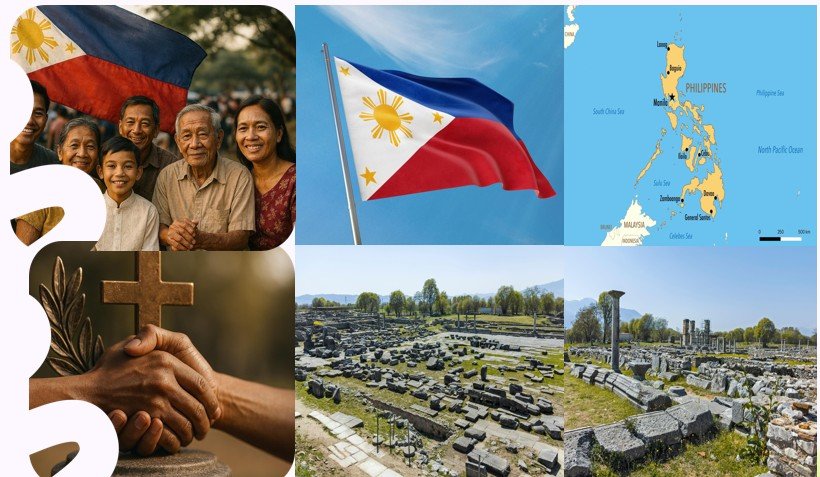
There is poetry hidden in the similarity of their names (Philippines and Philippians).
But clarity demands distinction.
The Philippines is a living nation- an archipelago of more than seven thousand islands, shaped by colonisation, resilience, faith, migration, typhoons, industry, and hope. It breathes in real time. It builds universities. It sends nurses across continents. It sings in churches and debates in parliaments. It rises after storms.
Philippians, however, is not a nation. It is a letter-the Epistle to the Philippians-written by the Apostle Paul to believers in the ancient Roman colony of Philippi (in present-day Greece). It is preserved in Scripture. It speaks from parchment, not from parliament.
And yet-though they are not the same-there is a compelling analogy between them.
1. A Roman Colony, A Global Nation
Philippi in Paul’s day was a Roman colony-proud of its citizenship, shaped by imperial culture, yet home to a small community of believers learning how to live faithfully within a complex political environment.
Modern Philippines is not a Roman colony, but it has known layered histories of external influence-Spanish, American, Asian, global. It stands today as a sovereign state navigating modern geopolitics, diaspora economics, and global partnerships.
Ancient Philippians were told: “Our citizenship is in heaven.”
Modern Filipinos live with dual identities-national and global-many serving abroad while remaining deeply connected to home.
Those of them who are kingdom-aligned, however, can boldly claim the citizenship of heaven.
One learned spiritual citizenship amid empire.
The other practices national identity amid globalisation.
Different contexts. Similar tensions.
2. Joy in Adversity
Paul wrote Philippians from prison-yet the letter radiates joy.
“Rejoice in the Lord always.”
It is a theology of resilient optimism.
The Philippines today knows adversity — natural disasters, economic disparities, public health challenges — yet remains globally known for resilience. After storms flatten provinces, communities rebuild. After hardship, families gather. After migration, remittances sustain households.
The letter to the Philippians teaches joy that transcends circumstance.
The people of the Philippines often embody joy that survives circumstance.
One writes it in ink.
The other lives it in experience.
3. Partnership in the Gospel, Partnership in the World
Paul commended the Philippians for partnership — they supported his mission materially and spiritually. The letter celebrates collaboration.
Modern Philippines is globally interwoven — nurses, teachers, seafarers, engineers, academics, missionaries. It participates in international education, healthcare exchange, and humanitarian networks.
Where Philippians speaks of “partnership in the gospel,”
the Philippines demonstrates partnership in global service.
One supported apostolic journeys.
The other sustains global systems.
4. Humility as Strength
Philippians 2 contains one of the most profound Christological hymns — describing humility, service, self-emptying love.
The Philippines, deeply shaped by Christian heritage, often expresses faith publicly — in festivals, prayer culture, service-oriented professions, and communal life.
The letter calls for humility of mind.
The nation often expresses communal solidarity in crisis.
One instructs humility.
The other frequently practices solidarity.
5. But Let Accuracy Stand
And yet-for all the poetic parallels-we must not collapse them into each other.
The Philippines is a country of 110+ million people, sovereign, evolving, complex.
Philippians is a 4-chapter New Testament epistle, theological, historical, canonical.
To confuse them is to blur geography with theology.
To distinguish them is to honour both.