There are moments in history when mercy is not merely a feeling-it becomes a movement.
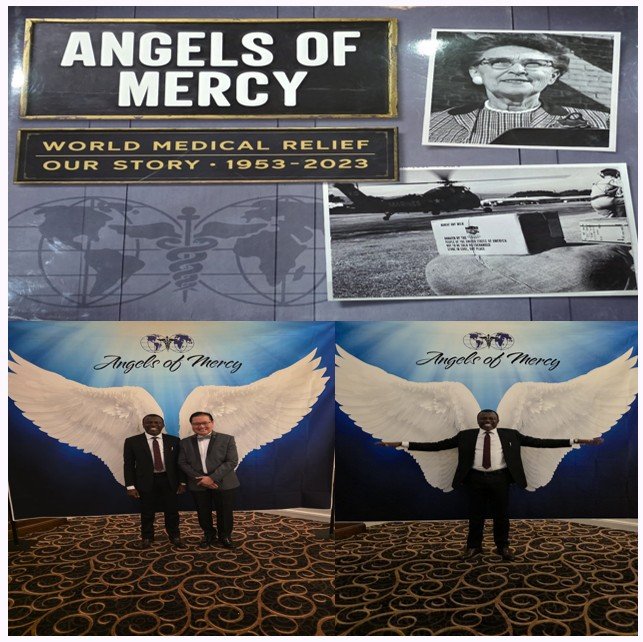
In 1953, when World Medical Relief (WMR) began its journey, the world was still nursing the wounds of war. Supplies were scarce in many regions. Hospitals were fragile. Entire populations stood on the thin edge between illness and survival. Into that gap stepped ordinary people with an extraordinary conviction: no life should be left without care simply because of geography or poverty.
They did not call themselves heroes.
They did not brand themselves saviours.
They simply chose to act.
And thus began what many have come to know as the work of Angels of Mercy.
Mercy That Moves
An angel, in its purest sense, is a messenger. A carrier of hope.
In medical missions, mercy travels not on wings, but in containers.
It travels in:
- Sutures that close wounds
- Gloves that prevent infection
- Monitors that guard fragile heartbeats
- Medicines that quiet pain
- Equipment that restores dignity
From warehouse shelves in Detroit to bedside monitors in underserved communities, compassion is translated into structure. Surplus becomes stewardship. Generosity becomes governance. Hope becomes hardware.
This is not charity as sentiment.
This is mercy organised.
Why True Medical Missions Still Matter
We live in an era of advanced technology, robotic surgery, artificial intelligence, and smart hospitals. Yet even now, entire communities remain medically invisible. Conflict displaces. Poverty delays care. Rural roads block access. Health systems strain.
Medicine has advanced.
Access has not advanced equally.
True Medical Mission exists in that space-not to replace systems, but to reinforce them. Not to perform for applause, but to build continuity. Not to create dependence, but to restore dignity.
True Medical Mission is:
- Compassion paired with competence
- Generosity paired with accountability
- Action paired with follow-up
- Presence paired with partnership
Without structure, mercy evaporates.
Without skill, compassion can harm.
Without continuity, intervention becomes interruption.
True Medical Mission insists on all three: heart, skill, and sustainability.
Angels in a Modern World
The black-and-white photographs of early relief efforts show helicopters, wooden crates, handwritten labels, and determined faces. They remind us that progress is not measured only in innovation- it is measured in inclusion.
An Angel of Mercy today may be:
- The donor who refuses to waste usable equipment
- The clinician who volunteers expertise
- The logistics coordinator who ensures cold-chain integrity
- The nurse who listens beyond symptoms
- The partner hospital that opens its doors
Angels are not mystical.
They are intentional.
They understand that a warehouse can become a ward.
That a shipment can become survival.
That a partnership can become policy.
Mercy as Responsibility
True Medical Missions are not about superiority.
They are about solidarity.
Where one system has rotation cycles, another struggles with shortages.
Where one nation discards, another pleads.
The moral question is not whether we can help.
It is whether we will structure that help responsibly.
World Medical Relief’s enduring story from 1953 to today stands as testimony that mercy, when disciplined, becomes transformative.
Because somewhere:
- A mother waits for safe delivery.
- A child waits for antibiotics.
- A rural clinic waits for basic instruments.
- A displaced family waits for dignity.
They are not waiting for pity.
They are waiting for structured compassion.
The Call Forward
Angels of Mercy are not a relic of the past.
They are a necessity of the present.
True Medical Mission remains urgent in our era because humanity has not outgrown vulnerability. Systems still fracture. Inequities still widen. Disasters still displace. And suffering still hides in places cameras rarely reach.
When mercy becomes organised, hope becomes durable.
And when hope becomes durable, lives change- not temporarily, but sustainably.
The question is no longer whether Angels of Mercy exist.
The question is:
Will you choose to be an Angel of Mercy?
~Dr Chukwudi Okebaram