
In a generation increasingly defined by moral uncertainty, technological disruption, leadership crises, and the growing struggle for values-based education, institutions rooted in character, ethical responsibility, and transformational learning are becoming more important than ever. Across the global academic landscape, Christian education continues to play a vital role in shaping not merely intellectually equipped graduates, but morally grounded leaders capable of influencing society with integrity, compassion, innovation, and purpose.
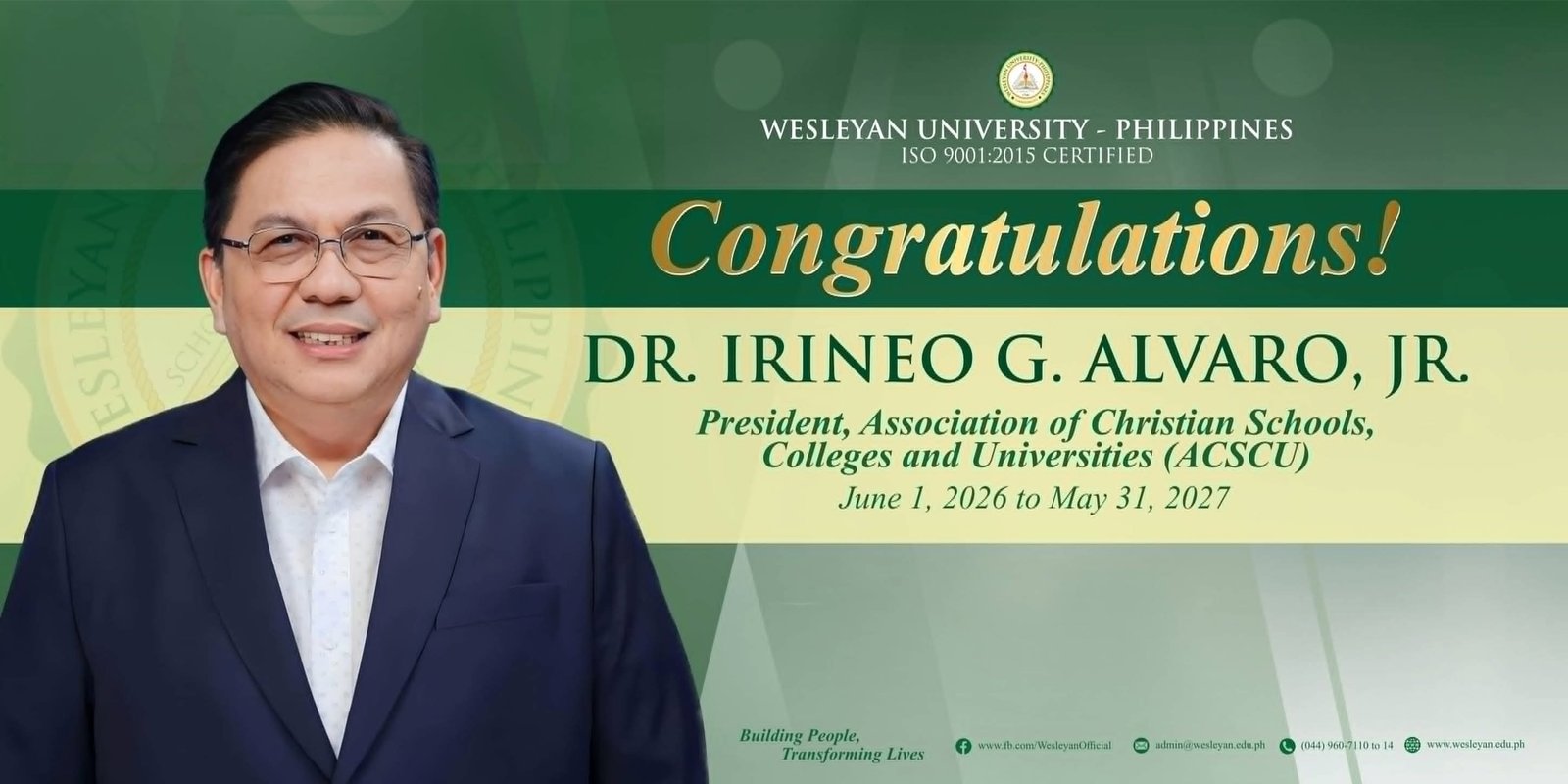
It is therefore both timely and significant that Dr. Irineo Alvaro Jr., President of Wesleyan University-Philippines, has been elected President of the Association of Christian Schools, Colleges and Universities (ACSCU) Philippines-one of the most respected faith-based academic associations in the nation.
This elevation is more than an administrative appointment. It represents a broader affirmation of visionary educational leadership, institutional excellence, and the enduring relevance of Christian-centered education in shaping the future of nations.
The recently announced ACSCU 80th Founding Anniversary and 64th National Convention, scheduled for May 11–13, 2026 at Silliman University, Dumaguete City, carries the deeply symbolic theme: “80 Years of God’s Grace: Educating for Christlike Character, Transformation, and Hope.” The theme itself reflects a profound truth often forgotten in modern educational systems-that true education is not solely about the transfer of information, but about the formation of character, values, wisdom, and societal responsibility.
Under the leadership of Dr. Irineo Alvaro Jr., Wesleyan University-Philippines has increasingly distinguished itself internationally through innovation, interdisciplinary advancement, institutional integrity, and future-oriented educational development. His leadership has consistently reflected a rare combination of intellectual depth, administrative excellence, humility, global engagement, and commitment to transformational learning.
In recent years, Wesleyan University-Philippines has continued to gain increasing international recognition for its forward-looking educational philosophy and innovation-driven institutional culture. Such progress demonstrates that Christian universities can remain spiritually grounded while simultaneously excelling in research, technology, interdisciplinary collaboration, ethical leadership, and global relevance.
For many observers within the global Christian academic community, Dr. Alvaro’s emergence as ACSCU President comes at a particularly critical moment. Around the world, educational institutions are facing complex challenges including declining moral frameworks, mental health pressures among students, technological acceleration, social fragmentation, and widening inequality in access to quality education. These realities demand leaders capable of balancing innovation with humanity, excellence with compassion, and progress with ethical responsibility.
This is why the significance of this leadership transition extends beyond the Philippines alone.
Faith-based institutions across Africa, Asia, Europe, and North America increasingly recognise the need for stronger international collaboration among Christian universities and educational networks. Partnerships that transcend geography are becoming essential for research advancement, leadership exchange, humanitarian engagement, public health education, technological development, and student empowerment.
It is within this broader context that the growing relationship between Wesleyan University-Philippines and RCN Medical Missions/RCN Medical Center Makurdi, Nigeria, becomes particularly meaningful. The partnership reflects a shared commitment to humanitarian service, transformational education, community impact, ethical leadership, and global collaboration rooted in Christian values.
Speaking on behalf of RCN Medical Missions, Dr. Chukwudi Okebaram described Dr. Alvaro’s election as “a fitting recognition of exceptional leadership, intellectual depth, administrative excellence, and steadfast commitment to advancing Christian education, ethical leadership, innovation, and nation-building.”
Indeed, history repeatedly demonstrates that societies rise or decline largely on the quality of their educational systems and leadership culture. Universities are not merely academic factories; they are incubators of civilisation. They shape the ethical imagination, intellectual direction, and social capacity of future generations.
The election of leaders who understand this responsibility is therefore of profound importance.
As ACSCU Philippines prepares to celebrate eighty years of Christian educational impact, there is growing optimism that this new phase of leadership will strengthen collaboration among Christian institutions, deepen academic excellence, promote moral and spiritual values, and inspire a new generation of transformational leaders capable of positively influencing both local communities and the wider global society.
At a time when the world desperately needs leaders of integrity, compassion, vision, and courage, the continued advancement of Christ-centered education remains not merely relevant, but essential.
And perhaps that is the deeper significance of this moment: that beyond titles, ceremonies, rankings, and conventions lies a larger mission-the shaping of lives, institutions, and nations through education anchored in truth, wisdom, service, and hope.